
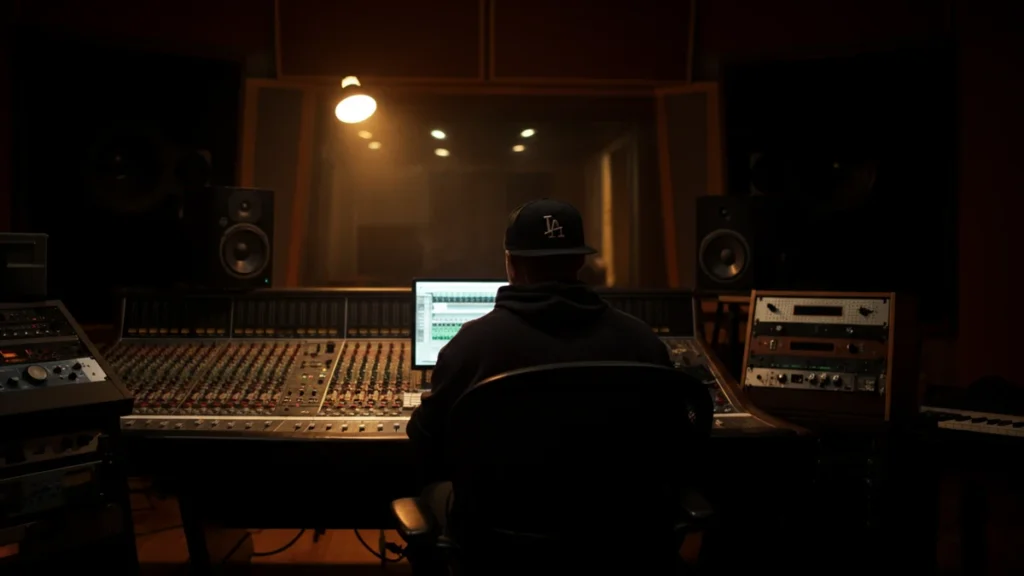
A hip-hop producer seen from behind at a mixing console in a dimly lit, professional recording studio. | RapStar.News - AI Generated
How a Super-Producer Became Hip-Hop’s Master Curator
In modern hip-hop’s ever-changing landscape, few figures loom as large as Leland “Metro” Wayne. He is professionally known as Metro Boomin. Once a hitmaker crafting trap anthems for the genre’s elite, he has since ascended to a new stratosphere. We are firmly in the midst of Metro Boomin’s collaboration era. This period features not just singular hits, but fully-realized, conceptually rich collaborative albums that dominate charts and conversations alike. His recent work, particularly with long-time creative partner Future, has solidified his status as a master curator. He uses the studio as a canvas to paint sprawling sonic narratives.
Metro Boomin’s transition from beatmaker to auteur has been gradual but deliberate. Producers have always been hip-hop’s backbone. However, Metro Boomin has elevated their role to that of a film director. He doesn’t just supply the backdrop. He sets the scene, casts the characters, and guides the emotional arc of the entire project. He clearly showed this approach in his star-studded solo albums, NOT ALL HEROES WEAR CAPES and the cinematic HEROES & VILLAINS. But it reached its commercial and critical peak with his 2024 album series with Future. These projects are more than just song collections. They are event releases, cultural moments. A producer at the absolute peak of his powers meticulously orchestrates them.
The ‘WE DON’T TRUST YOU‘ Saga: A Generational Moment
The one-two punch of WE DON’T TRUST YOU and its follow-up, WE STILL DON’T TRUST YOU, best exemplifies Metro Boomin’s collaboration era. These albums with Future came out quickly in early 2024. They weren’t just big commercial successes; they were a seismic event. Released under Boominati Worldwide and Republic Records, the projects captured the industry’s full attention. They debuted at number one on the Billboard 200 and set streaming records.
The explosive track “Like That” was the centerpiece of this monumental run. It featured a surprise, scorchingly competitive verse from Kendrick Lamar. The song immediately became the most talked-about record of the year. It shot to number one on the Billboard Hot 100. This happened not just for its undeniable energy, but because it escalated the long-simmering tensions between Kendrick Lamar, Drake, and J. Cole. Still, the song’s success testifies to Metro Boomin’s genius. The menacing, sample-driven beat provided the perfect arena for the lyrical showdown. This proved Metro knows exactly how to create the conditions for a classic moment.
He didn’t just produce a beat; he produced a battlefield, and the entire world tuned in to watch.
Beyond the headline-grabbing diss track, the albums are a masterclass in cohesion. Metro Boomin’s dark, atmospheric production provides a consistent sonic thread. This allows Future’s toxic-yet-vulnerable persona to flourish. He chooses features with surgical precision. Artists like The Weeknd on “We Still Don’t Trust You” and Travis Scott on “Cinderella” feel like essential parts of the narrative. They are not just tacked-on additions. This level of curation demonstrates Metro’s deep understanding of artistry and album-making, setting him apart.
The Producer as Auteur: Redefining the Role
The concept of a producer-led album is not new. DJ Khaled, for example, has built empires by assembling star-studded collaborations. Underground legends like The Alchemist earn reverence for their distinctive sonic palettes, which attract top-tier lyricists. However, Metro Boomin’s approach feels distinct. Some producer albums can feel like a playlist or a showcase of connections. In contrast, Metro builds his projects with a singular, unified vision.
His albums play out like dark, superhero-themed blockbusters. Titles like HEROES & VILLAINS make this concept explicit. This cinematic quality is his signature. He uses skits, interludes, and recurring motifs to build a world for the listener. He casts collaborations like roles in a film. He chooses each artist for how their specific persona and sound fit into the larger story he is telling. For example, his work with 21 Savage on albums like *Savage Mode* and *Savage Mode II* created a definitive sound for the rapper. It essentially co-authored his artistic identity. This is the hallmark of Metro Boomin’s collaboration era: a partnership where the producer is as integral to the final artistic statement as the vocalist.
The “BBL Drizzy” Beat: Weaponizing the Culture
Metro Boomin further cemented his status as a master manipulator of the cultural zeitgeist. He found a novel way to engage in the rap beef that “Like That” had supercharged. Drake released a diss track. In response, Metro didn’t fire back with bars. Instead, he created and released a beat titled “BBL Drizzy”. This playful, soulful instrumental mocked his rival. He uploaded it to streaming services and encouraged fans to rap over it, effectively crowdsourcing the diss.
The move was brilliant. It turned a tense rap feud into a viral, participatory event. The “BBL Drizzy” beat became a phenomenon on platforms like TikTok and X. Thousands of users created their own versions. More importantly, Metro Boomin announced the challenge winner would receive a free beat and a $10,000 cash prize. This strategic jujitsu allowed him to simultaneously troll his opponent, engage his fanbase, and dominate the cultural conversation. It was a checkmate move. It demonstrated media savvy far beyond that of a typical producer. He showcased his deep understanding of how music and culture intersect in the digital age.
What’s Next for the Super-Producer?
After a career-defining run, the question becomes: what’s next? With the success of his album series with Future, the possibilities seem limitless. Fans are already clamoring for full-length collaborative projects with other frequent partners, including:
- A full album with The Weeknd, given their proven chemistry on tracks like “Creepin'” and “Heartless.”
- A third installment of the Savage Mode series with 21 Savage.
But Metro Boomin may have his sights set even further. He has conquered hip-hop. Now, he could easily pivot to other genres, bringing his cinematic approach to pop, R&B, or even film scoring. His production on HEROES & VILLAINS already felt like the soundtrack to a movie that doesn’t exist. It’s not hard to imagine him helming an official score for a major motion picture. He could translate his world-building skills from the studio to the silver screen.
Whatever he chooses, one thing is clear: Metro Boomin’s collaboration era is far from over. He has fundamentally altered the power dynamics of the music industry. He proves that a producer with a strong vision can be the biggest star in the room. He is no longer just making beats. He is building worlds, and the entire industry is eager to get an invitation.
His work orchestrating cultural moments is part of a larger trend. This sparks conversations about what’s next for the Opium King.
Join the Next Wave of Music Creation
Artists like Metro Boomin display innovation and creative vision. This reshapes the music industry. For creators, producers, and industry professionals, staying ahead of the curve requires the right tools and insights. At RapStar.News, we dedicate ourselves to covering trends and technologies that empower the next generation of music. Explore the platforms making it all happen and find your own path to creation.
About Author