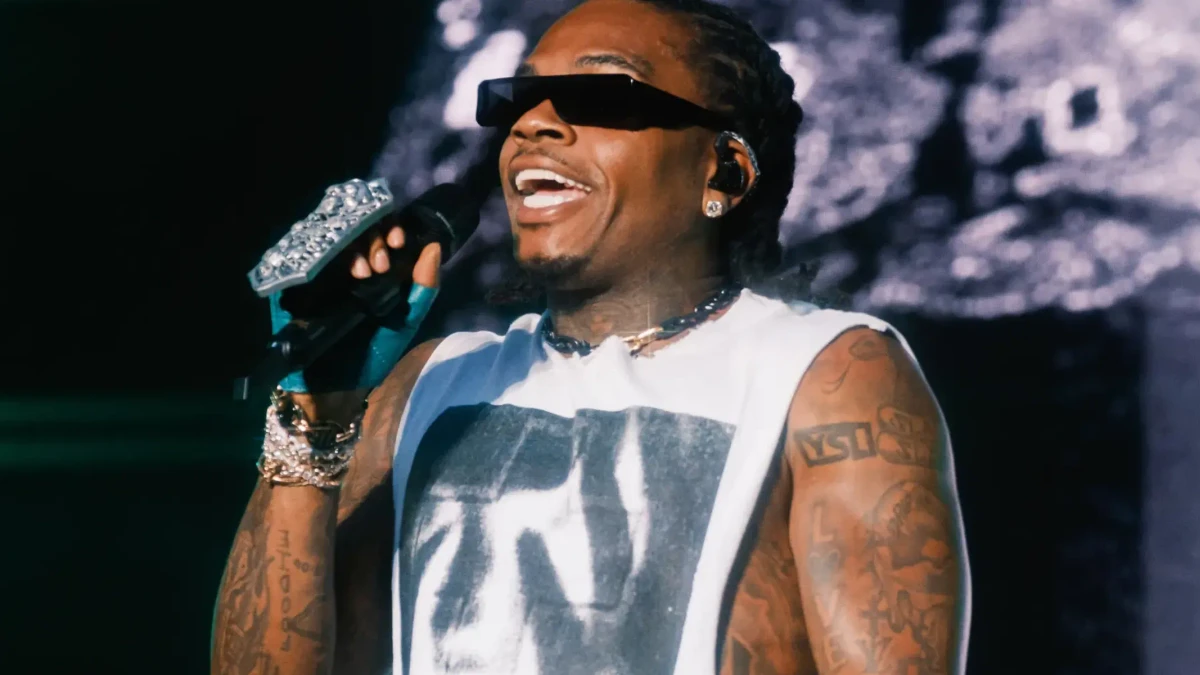

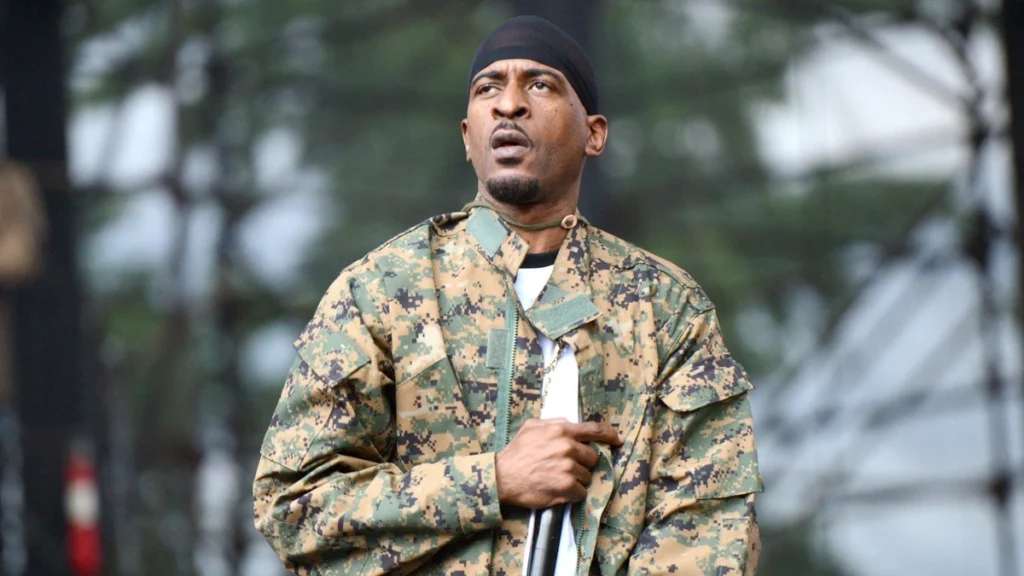
Rakim performing in Irvine, California.
Rakim performing in Irvine, California.
Three writers with nothing left to prove is an unusual place to start a record. The Godbody LP puts Rakim, Kurupt and Masta Killa on the same fifteen tracks, out on 18 September through Team League Entertainment, and the pitch is not nostalgia. It is geography.
Rakim has been direct about what the project is for. The point is to break down the lines rap spent three decades drawing between one coast and another, and to do it by putting writers from opposite sides of those lines on the same beats.
Three Writers, One Tracklist
The pairing is deliberately awkward on paper. Rakim is the foundational New York technician. Masta Killa came up inside Wu-Tang, the most closed-off crew in the genre’s history. Kurupt built his catalogue on the West Coast with DPG.
Those are three different pockets. Rakim writes long, internally rhymed lines that sit slightly behind the beat. Masta Killa is the most patient writer in his crew, and habitually the last voice on a posse cut. Kurupt is quick, front-footed and built for the bar-trading that West Coast records were structured around.
Fifteen tracks is enough room for that to be a feature rather than a collision. It is also enough room for it to fail, because a record built on contrast has to sequence the contrast rather than average it out.
What Rakim Says About the Age Limit
The other argument the album is making is about who gets to keep releasing records. Rakim has been plain about that too, and about having disagreed with the genre’s assumptions on it for a long time.
He has said he always hated that hip-hop felt there was an age limit, that he quietly disagreed with it, and that one of the ways he tried to show there isn’t one was simply to keep working at a high level. On the evidence of the release calendar around him, that argument is now being won by attrition.
He is not the only veteran shipping an album into this window. Big Daddy Kane and Too $hort have records out, and LL COOL J and MC Lyte have both returned with well-received projects after long gaps. A genre that spent years treating thirty-five as a retirement age now has a functioning catalogue tier.
Rakim frames the difficulty honestly rather than triumphantly. He has described the pull between evolving and staying true to what he does, and the pressure from newer listeners who expect an older artist to sound like the present. His stated answer is to stay in touch with what made him while making sure the record belongs to now.
Why Regionalism Is the Target
The clearest statement of intent came in his conversation with Vibe. “What I love about doing projects like this is it breaks down the barriers of East Coast, West Coast, the Dirty South, Midwest — wherever you’re from,” he said. “It’s a group of artists getting together to show how they love music, and how groups and people can come together from different cities and different styles. It’s like a melting pot of hip-hop. It’s bringing a bunch of artists together to do different things.”
That framing matters more than it might read now. The East-West divide was not a marketing device; it structured touring, radio, distribution and, at its worst, considerably more than that. Rakim, Kurupt and Masta Killa were all working through the period when those lines were hardest.
Three artists from opposite sides of that history making a record together is therefore a statement the participants are entitled to make, and one younger collaborators could not make in the same way.
The Features Read Like a Map
The guest list is where the argument becomes a tracklist. Snoop Dogg, Raekwon, Kokane, Daz Dillinger, Killa Sin, Mac Shawn 100, Jamall Ray, Buckshot, RIM, Trigga tha Gambler, KRS-One and Kool G Rap all appear, alongside a Wu-Tang guest verse.
Laid out, that list is the point rather than a promotional flourish. KRS-One and Kool G Rap belong to the same New York generation as Rakim. Snoop, Daz and Kokane are the West Coast lineage Kurupt came up in. Buckshot, RIM and Trigga tha Gambler carry the Brooklyn end of the 1990s.
There is also a special interlude featuring Eminem and Jay-Z, which is a different kind of credit. Both have named Rakim as a formative influence for their entire careers, and putting them on an interlude rather than a verse keeps the record’s centre where it belongs.
Who Is on the Boards
Production is credited to Rakim himself alongside Nick Wiz and Nick Price. That is a small, closed production team for a record with this many voices on it, and it is the correct decision for exactly that reason.
A guest list of this size pulls a record apart if every feature brings a producer. One consistent set of beats gives fifteen tracks a spine, and it forces the contrast between the writers into the foreground rather than burying it under fifteen different mixes.
Nick Wiz is a specific choice too. His catalogue is rooted in exactly the 1990s East Coast sound the record is drawing on, which suggests a production floor built to hold a Rakim verse rather than to modernise one.
Cohesion is what carries a long tracklist, and the pocket is where it lives. The site has written before about a rapper holding the pocket across eleven tracks; doing it across fifteen with a dozen guests is a considerably harder job.
Two tracks are already out. “A Different Kind” arrived first, followed by “DPG-Wu-Tang, Wu-Tang-DPG”, whose title states the crossover explicitly rather than leaving it to the credits.
Naming a single after two crews from opposite coasts is the least subtle possible version of the album’s thesis, and that appears to be intentional. A listener who only hears one track should still understand what the record is doing.
The Catalogue Each One Brings
Part of what makes the pairing legible is how differently each of the three has used the last decade. Rakim has released sparingly and toured steadily, which has kept his catalogue small and his live reputation intact. Masta Killa has been the most consistent solo releaser of the Wu-Tang members, putting out records at a pace the crew’s bigger names abandoned years ago. Kurupt has worked continuously across group projects, features and West Coast reunions.
Those are three different answers to the same problem, which is what a rapper does after the era that made them ends. One rationed the output, one kept a steady release schedule, one stayed inside a scene. All three arrive at this record with an audience intact and none of them arrive needing it.
It also means none of the three is the obvious lead. A collaboration where one name is clearly the draw tends to become that artist’s album with guests, and the credits here are structured to prevent it: three principals, shared across fifteen tracks, with the production held by one team rather than split by whoever brought the beat.
The genre has a poor record with this format, which is worth stating plainly. Veteran supergroups usually produce a good single and a patchy album, because the writers involved rarely have a reason to be on the same record beyond the billing. What separates this one, at least in the stated intent, is that the reason is the point: the coast line the three of them came up on opposite sides of is the subject, not the obstacle.
What the Eighteenth Settles
The risk with a project like this is the compilation problem. Fifteen tracks, three principals and a dozen guests can produce a record that is a series of appearances rather than an album, and veteran collaborations fail that way more often than they succeed.
What is set up against that is a single production team, a stated thesis, and three writers whose styles are different enough to be worth sequencing. Okayplayer’s report and the Vibe interview it draws on both put the emphasis on the collaboration itself rather than on any one verse.
The release lands on 18 September. The full credits list the guests, the producers and the label, and the question the record has to answer is whether three writers who spent their careers on different sides of a line sound like one album when you put them on the same beat.
About Author